Ecopalypse & Enchantment
Rachel Carson, John Keats, and Missing Moral High Ground of 2026

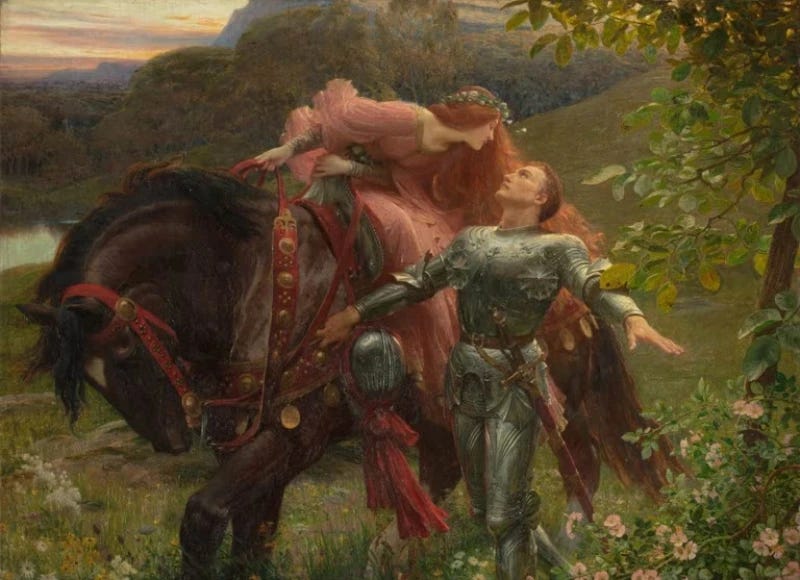
La Belle Dame sans Merci, 1902, by Sir Frank Bernard Disksee
I got curious about something last week as I was writing my monthly poetry column for Tricycle: The Buddhist Review. The winning poem for the March 2026 Haiku Challenge alluded to a book published when I was five years old that I hadn’t gotten around to reading until the 1994.
That was the year my brother, a biologist who studies plant populations, introduced me to the Holocene extinction—a slow-motion apocalypse sometimes called the Anthropocene extinction because its principal driver is human progress. I prefer to think of it as the ECO•PALYPSE, which brings the human and environmental End Times together in a single word.
My curiosity was about the title, Silent Spring. Rachel Carson had articulated the idea in the book’s most elegiac, oft-quoted passage:
Over increasingly large areas of the United States, spring now comes unheralded by the return of the birds, and the early mornings are strangely silent where once they were filled with the beauty of bird song. This sudden silencing of the song of birds, this obliteration of the color and beauty and interest they lend to our world have come about swiftly, insidiously, and unnoticed by those whose communities are as yet unaffected.
The writer in me knew that a paragraph with that much moral suasion had to have its roots in some deeper literary strata than mid-century American science writing. I was right. The chapter’s title “And No Birds Sing,” sent me back to the front matter to look for an epigraph, and there it was. I understood at once why Carson had chosen it.
Written in 1819 in the early decades of the Industrial Revolution, John Keats’ ballad “La Belle Dame sans Merci” tells the story of a knight who has fallen under a faerie enchantment. As the world around him grows dark and cold, the knight too becomes drained of color and life. The opening stanza, spoken by the narrator, sets the scene:
O what can ail thee, knight-at-arms,
     Alone and palely loitering?
The sedge has withered from the lake,
     And no birds sing.
Carson cited only the last two lines of the stanza for her epigraph. In a letter to her friend and confidante Dorothy Freeman, she said simply “the Keats helps explain the title.”
But it does a lot more than that.
The poem is about an enchantment that transports the knight to an illusory realm where he falls in love with a faerie girl. He sets her on his steed and they ride all day, foraging roots and wild honey. Finally, they arrive at her elfin grotto where she lulls him to sleep.
The shift in the poem occurs here. For in a dream the knight awakens from the enchantment to the truth of his situation:
I saw pale Kings, and Princes too,
     Pale warriors, death-pale were they all;
They cried ‘La belle Dame sans merci
     Thee hath in thrall.’

I saw their starv’d lips in the gloam
     With horrid warning gaped wide,
And I awoke, and found me here
     On the cold hill’s side.

And this is why I sojourn here
     Alone and palely loitering
Though the sedge is withered from the Lake,
     And no birds sing.
We can imagine why Carson didn’t want to elaborate on a poem from the all-male canon that casts yet one more woman in the role of seductress. Had you asked her to identify the “The Beautiful Lady without Mercy” within the moral universe of Silent Spring, she would have said it wasn’t a lady at all who held 20th century America in thrall, but the idea of human supremacy—of limitless growth and progress at the expense of the natural world.
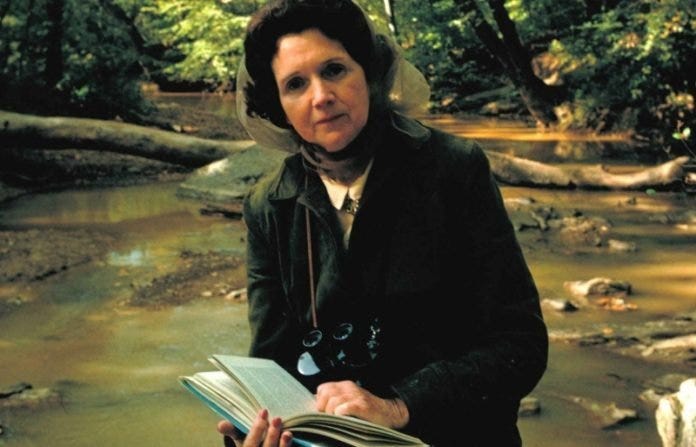
Alfred Eisenstaedt/Time Life Pictures, via Getty Images
I can’t say for certain what Rachel Carson was thinking when she linked Keats’ poem with the title of her book, but I do know how an author chooses an epigraph to telegraph the theme of book that follows it. My guess is, Carson saw herself as the narrator who sets the poem in motion by asking the same question that Parsifal asks of the Fisher King in the Grail legend: “What ails thee?”
Both the poem and the book are answers to that question. The Grail legend tells a similar story. When the Fisher King was wounded, the fields became fallow and eventually the Earth itself became a wasteland. In the legend, the spell is broken by “the healing question,” and both the king and the land regain their vigor.
Maybe that is what Carson was hoping for. In the short run, that is what she got. Although she didn’t live to see it. The Environmental Protection Agency was created in 1970, and DDT was banned two years later. Two decades later, her beloved American robin, which had been driven to near extinctio by pesticides, had completely rebounded.
But that was then. This is now.
It took some time to realize the difference that sixty years can make—and why. In 1962, it was still possible to ask the healing question of a species bent on ecocide because there was still the sense of an environmental “moral high ground” from which the question could be asked. The worst “forever chemicals” had yet to be created, and it was still possible to imagine a monolithic agro-industrial villain like DDT. Returning to the mythic framework of knights and kings and ladies, it was then still possible to imagine eliminating environmental evil by simply “killing the giant.” Now WE are the giants. And who is left to question us but ourselves?
The illusion that lies at the heart of modern, Earth First environmentalism is that of the narrator who can tell the terrible, sad tale of what we are doing to the planet because he, she, they, or whomever are not a part of the story.
When I try to imagine how it could have come to this, I find myself back in the same exact place each time. I look about me to see if there is some higher ground from which the declaim the ecopalyse we are currently living in (because I want to declaim it as much as the next person, and probably more) but the world is flat as far as the eye can see.
Maybe there is a cold hillside someplace where one can still find pale Kings and Warriors who believe they are blameless—or at least hapless—because “La Belle Dame sans Merci” has them in thrall. But the truth is WE have done this. And we are STILL doing it.
The enchantment we call human civilization isn’t done with us yet, and it may be that, when the healing question comes, it won’t be a narrator or a questing knight who asks it, but some future version of ourselves. Some species who—against all odds—has survived the worst thir ancestors could do to the planet and wants to try again.
I love how you have framed this Clark. ❤️